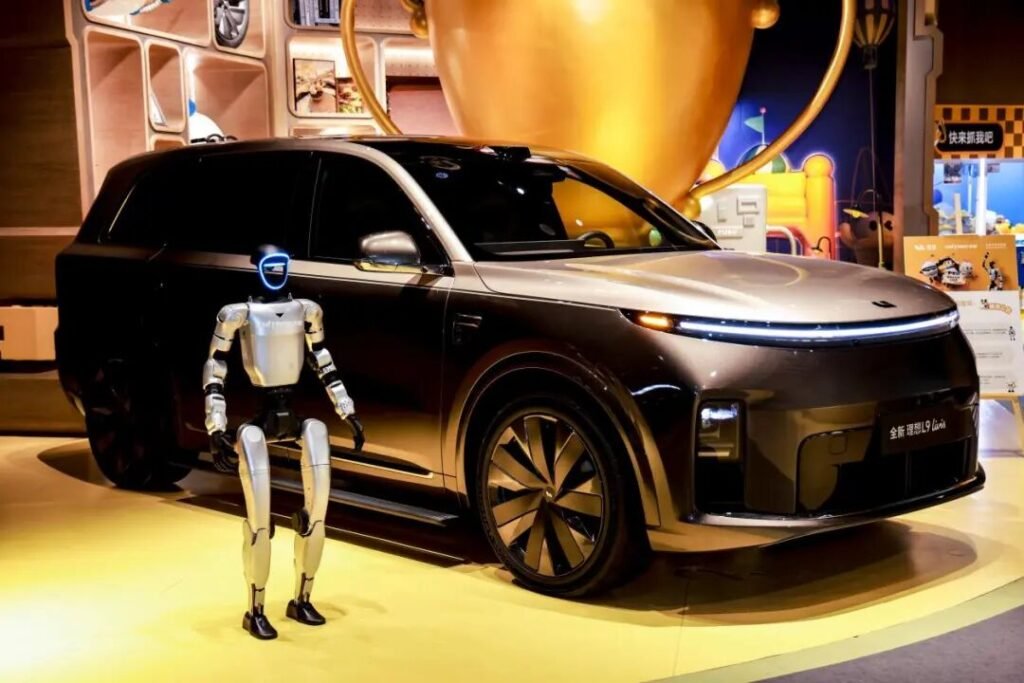
It looks like a clever marketing stunt. But beneath the novelty is a much bigger question for China’s humanoid robotics industry: now that the robots can be built, where will they actually work?
Two days after Unitree Robotics went public, one of its humanoid robots apparently got a new job.
Not in a factory. Not in a research laboratory.
At Li Auto.
Just days after Unitree rang the bell on the Shanghai Stock Exchange’s STAR Market on August 19, its humanoid robots appeared at Li Auto experience centres wearing company uniforms and employee badges.
Their new job title?
AI Experience Officer.
The first stops reportedly include the Beijing Automobile Museum, Zhuhai Chimelong and a Li Auto experience centre in Zhengzhou.
On the surface, this looks like textbook corporate marketing.
Unitree has just gone public and needs attention. Li Auto sells cars and needs something people will talk about.
Everyone wins.
But if you step back from the publicity stunt, the collaboration reveals something much more important about the humanoid robotics industry.
The hardest question is no longer whether engineers can build a humanoid robot.
It is:
What happens after they build it?
From IPO to “employee” in 48 hours
Li Auto has given the robot everything a new employee might need: a uniform, an employee badge and a schedule covering multiple locations.
It is easy to dismiss the whole thing as a publicity stunt.
I don’t think we should.
For Unitree, this is an unusually effective way to turn the excitement surrounding its IPO into something consumers can actually see.
Most people have no idea how much torque a robotic joint can generate. They don’t care about actuator specifications or control algorithms.
But put a humanoid robot inside a car showroom and suddenly everyone understands the product.
Can it stand there?
Can it talk to customers?
Can it explain a car?
Can it respond when someone asks an awkward question?
That kind of visibility may be one of the cheapest ways for consumer robotics to move from engineering circles into the mainstream.
And the timing is hardly accidental.
Unitree has just had what might be described as a super week.
Unitree’s big week
On August 19, Unitree became the first humanoid robotics company to list on China’s STAR Market, raising RMB 6.099 billion. Its shares surged as much as 629% during the first trading session and still finished the day up 460%.
The company reported 2025 revenue of RMB 1.699 billion and more than 5,500 humanoid robots shipped, according to the original report.
Just two days earlier, Unitree had unveiled a new humanoid robot, nicknamed “Superman”, claiming a standing vertical jump of two metres and a top speed of 12.66 metres per second.
At the World Robot Conference in Beijing, held from August 19 to 23, Unitree also showcased its G1 humanoid robot playing table tennis against a human and unveiled its three-metre-tall passenger-carrying robot, GD01.
The G1 starts at around RMB 99,000.
And Unitree founder Wang Xingxing has suggested that a breakthrough point for general-purpose robots could arrive within two to three years.
For someone living in Australia and watching China’s technology sector from the outside, this is perhaps the most striking part.
The speed at which Chinese companies move from prototype → product → public market → commercial testing is difficult to ignore.
But going public changes the question.
Before the IPO, Wang Xingxing and his team needed to prove that robots could actually do impressive things.
After the IPO, investors will eventually ask much less glamorous questions.
How many can you sell?
Who are the customers?
What is the revenue model?
And, most importantly:
What are all these robots actually going to do?
The showroom may be a harder test than the factory
The obvious first destination for humanoid robots is the factory.
搬运, sorting, inspection and assembly are all relatively structured tasks. The environment is controlled, the movements are repetitive and the economic value is relatively easy to calculate.
That is why industrial environments have become the natural starting point for many robotics companies.
But if humanoid robots are eventually going to become the next trillion-dollar technology platform, spending their entire working lives tightening screws is probably not enough.
The bigger opportunity may be outside the factory.
It may be standing directly in front of people.
And that is why a car showroom is actually a surprisingly difficult test.
Imagine two customers walking into a Li Auto store.
One patiently listens while the robot explains the vehicle’s interior space and seating configuration.
The other immediately asks:
“Stop talking around it. What’s the lowest price?”
Now the robot has a rather different problem.
Can it understand the customer’s intention?
Can it respond naturally?
Can it handle unexpected questions?
Can it maintain a conversation?
And, eventually, can it actually help sell a car?
That is a much harder challenge than demonstrating a perfectly rehearsed movement on a stage.
A robot that can sell a car may be considerably more valuable than one that can simply perform an impressive backflip.
Li Auto doesn’t really need another employee
There is another interesting layer to this partnership.
Li Auto does not appear to be buying thousands of robots or signing some enormous commercial procurement agreement.
Instead, it is effectively opening up a series of real-world testing grounds.
A museum.
An amusement park.
A car experience centre.
Each environment comes with different customers, layouts and interaction requirements.
That is precisely the transition where many technologies struggle: moving from something that works in a demonstration to something that works in the real world.
And Li Auto is a particularly interesting partner.
Founder and CEO Li Xiang has never hidden his interest in robotics. Li Auto has already been developing its own humanoid robotics programme.
From his perspective, autonomous driving and humanoid robotics are not necessarily two completely separate businesses.
Both are forms of embodied intelligence.
One happens to have four wheels.
The other has two legs and two arms.
That creates an intriguing possibility.
Today’s partner could eventually become tomorrow’s competitor.
The robot currently standing in a Li Auto showroom may be supplied by Unitree.
But there is nothing stopping Li Auto from eventually building its own robots and putting them into its factories, stores — or even customers’ homes.
Still, that is a problem for another day.
The industry is nowhere near the stage where companies are fighting over a mature market.
Right now, the more important task is to prove that the market exists in the first place.
And for that purpose, a major carmaker opening its real-world environments to humanoid robots may be far more meaningful than another viral video of a robot doing a spectacular trick.
The real test begins after the applause
For Unitree, the IPO marks an important change in identity.
Until now, Wang Xingxing has largely been seen as an engineer-entrepreneur: someone focused on making robots faster, cheaper, more capable and more reliable.
Now he has another job.
He is the CEO of a publicly listed company.
That means answering the boring questions every listed-company executive eventually faces:
Who are the customers?
How fast can sales grow?
Where will the revenue come from?
And perhaps the hardest question of all:
How do you keep thousands — or eventually millions — of robots economically useful every day?
Building one humanoid robot that can walk, jump and perform impressive tricks is already extremely difficult.
Building 10,000 robots is harder.
Making sure those 10,000 robots all have something useful to do every day may be harder still.
That transition will not generate the same excitement as an IPO bell or a spectacular backflip.
But it may ultimately determine whether humanoid robotics becomes a genuine industry or remains an impressive technological experiment.
Perhaps that is the real significance of Unitree’s unusual new employee.
One day, robots going to work may no longer be newsworthy.
And when that happens, we may finally know that the industry has arrived.