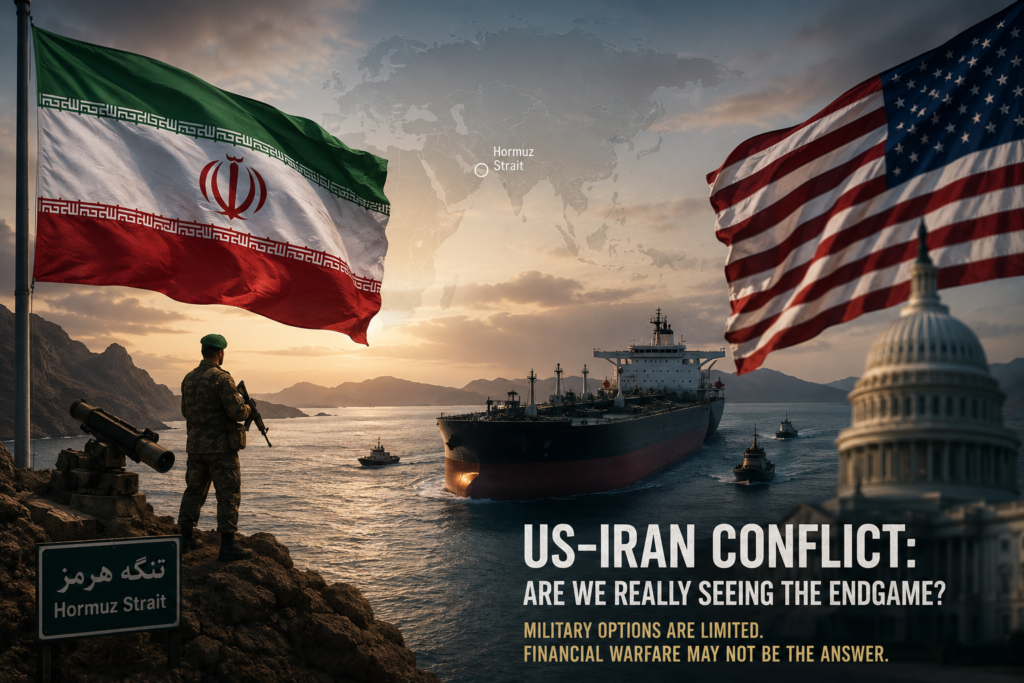
Washington says the conflict is entering its final phase. But the reality on the ground may point to something very different: a longer, more difficult confrontation.
Iran may finally have found a strategy that is forcing Washington to rethink its approach.
Since Mojtaba Khamenei has gradually taken on a more influential role and Iran has begun adjusting its strategy towards the United States, the balance of pressure appears to have shifted. Iran’s position has become noticeably harder, particularly following changes to the leadership of its Supreme National Security Council.
What is particularly striking is what has not happened.
As Iran has adopted a tougher posture, the United States has not launched another direct attack against Iran during this period. That suggests Washington may have discovered the limits of military pressure. For years, the assumption was that escalating pressure would eventually force Tehran to compromise. But that strategy appears to be producing diminishing returns.
Iran’s current approach rests on two important principles.
The first is control over the Strait of Hormuz.
The second is a refusal to leave much room for compromise with Washington.
Hormuz changes the equation
For Iran, the Strait of Hormuz is more than a strategically important waterway. It is one of the most powerful forms of leverage available to Tehran.
A huge proportion of the world’s oil and gas exports from the Gulf pass through the strait. Saudi Arabia, the United Arab Emirates, Kuwait, Qatar and other Gulf producers remain heavily dependent on this route to reach global markets.
That means any serious disruption to Hormuz immediately becomes a global economic problem.
And this is where Iran’s position becomes particularly uncomfortable for Washington.
Iran has apparently moved away from earlier attempts to find compromises that would allow shipping to continue under some form of negotiated arrangement. Instead, Tehran appears increasingly willing to use its geographical advantage directly.
According to recent data from the shipping intelligence company Kpler, only two commercial vessels passed through the Strait of Hormuz on August 24 — the lowest daily traffic level since early May. One was a very large LNG carrier and the other a very large crude oil tanker, compared with an average of around 14 vessels a day over the previous ten days.
The numbers matter because this is not simply an argument about Iran and the United States.
It is an argument about global energy security.
From Australia, this is particularly easy to appreciate. We may be geographically far from the Middle East, but energy markets do not care about geography. A disruption in Hormuz can quickly translate into higher fuel costs, inflationary pressure and financial-market volatility far beyond the Gulf.
This is why Iran does not necessarily need to defeat the United States militarily to gain leverage.
It only needs to make the economic consequences of further escalation increasingly painful.
Washington’s military option is running out of room
The bigger problem for the United States, however, may be that military pressure has become increasingly difficult to sustain.
A limited strike may not change Iran’s strategic behaviour. A much larger military campaign, meanwhile, carries enormous political and economic risks.
In other words, Washington faces an uncomfortable choice.
Do too little, and Iran remains defiant.
Do too much, and the conflict could expand into something the United States may not be able to control.
That is where US Treasury Secretary Scott Bessent’s latest comments become significant.
On August 23, Bessent wrote in the Financial Times that the US-Iran conflict was entering its “endgame” and said Washington was preparing what he described as the largest financial offensive ever directed against an adversary. He compared the coming economic campaign to a “D-Day” operation in financial warfare and said the United States would push allies and other countries to stop trading with Iran.
A day later, Bessent said President Donald Trump was personally calling foreign leaders and asking them to end their economic dealings with Tehran.
On the surface, this sounds like escalation.
But I see it differently.
It may actually be evidence that Washington is running out of better options.
Can financial warfare achieve what military force could not?
This is where I become sceptical of the “endgame” argument.
If military pressure cannot force Iran to change its behaviour, why should a stronger version of economic pressure suddenly succeed?
The United States has been imposing sanctions on Iran for decades. Sanctions have certainly inflicted economic damage, but they have not fundamentally changed the Iranian government’s strategic direction.
The same problem can be seen elsewhere.
Cuba has lived under extensive US sanctions for decades. The country has certainly suffered economically, but it has not collapsed.
Sanctions can create pressure. They can constrain an economy. They can raise the cost of doing business.
But pressure is not the same thing as capitulation.
That distinction matters.
If sanctions alone were sufficient to achieve Washington’s political objectives, there would have been little reason to repeatedly consider military options in the first place.
Now the United States appears to be moving in the opposite direction: military pressure has reached its limits, so Washington is turning back to economic pressure.
That looks less like an endgame than a change of tools.
And perhaps that is the most important point.
Bessent may be describing the end of one phase of the conflict, rather than the end of the conflict itself.
The real problem may be inside America
There is another factor that Washington cannot easily escape: its own economy.
Morgan Stanley strategists have warned that another surge in oil prices could become one of the biggest risks facing US equities. Higher oil prices could feed into inflation, push Treasury yields higher and eventually force the Federal Reserve to respond.
This is an important distinction.
It is not simply that higher oil prices are bad for American stocks.
The bigger risk is that a deterioration in the US-Iran conflict could push oil prices higher, which could then increase inflationary pressure, raise Treasury yields and ultimately create broader problems for US financial markets.
That chain of events helps explain some of the seemingly contradictory signals coming out of Washington.
The United States needs to demonstrate strength.
But it also needs to avoid an uncontrolled escalation.
It wants Iran to back down.
But it does not necessarily want oil prices to surge.
It wants its allies to isolate Tehran.
But it also needs the global economy to remain stable.
These objectives do not always point in the same direction.
And that is precisely why the next few weeks could be so important.
Iran may have fewer internal cracks than Washington expected
There is also a political development inside Iran that should not be underestimated.
Iran appears to have become more internally unified in response to the confrontation with the United States. The government’s external messaging has become more consistent, making it considerably harder for Washington to exploit internal divisions or find political pressure points inside the country.
If that assessment is correct, the traditional American strategy of combining military pressure with diplomatic and internal political leverage becomes much harder to execute.
And this creates an unusual situation.
Washington may want a way out.
But Tehran may have little incentive to provide one.
If Iran refuses to give the United States an easy diplomatic exit, Washington will have to construct that exit itself.
This is why I would not describe the current situation as an “endgame” just yet.
It looks more like the beginning of a prolonged confrontation in which both sides are trying to manage the cost of backing down.
For Washington, the challenge is increasingly about finding a way to claim strategic success without committing to a much larger war.
For Tehran, the calculation may be simpler: maintain control of its key leverage points, avoid unnecessary concessions and wait for the economic and political pressure on the United States to increase.
In that sense, the most interesting question may no longer be whether the United States can force Iran to surrender.
It may be how Washington gets itself off the battlefield without looking as though it has lost.
And if Tehran is unwilling to provide that political exit, Washington will have to find one somewhere else.
My suggestion?
Start with Benjamin Netanyahu.